
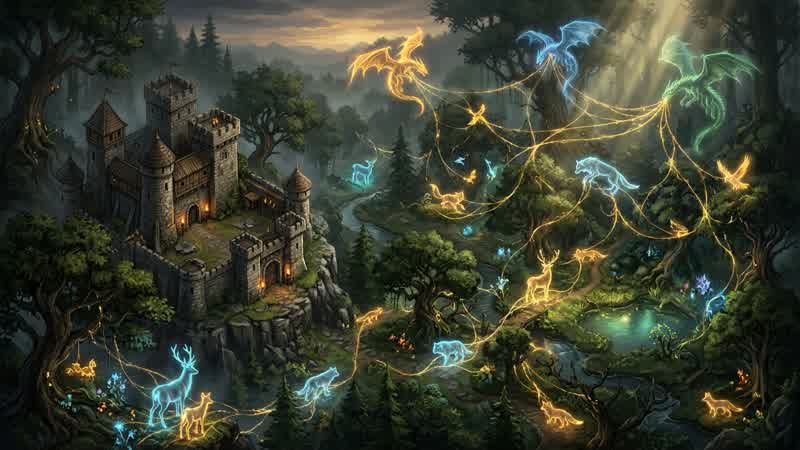
Before Ultima Online launched in September 1997 and popularized the modern graphical MMORPG, lead designers Richard Garriott ("Lord British"), Raph Koster, and Starr Long had a vision far grander than simple monster spawn timers. They wanted the world of Britannia to function as a genuine living virtual ecology.
For months, Origin Systems' programmers wrote an interconnected thermodynamic food chain across every forest, meadow, and mountain region on the server. Yet not a single player ever realized the system existed—because the moment beta testers logged in, they obliterated the entire ecosystem faster than the simulation could reproduce.
Title: How Ultima Online's 1997 Virtual Food Chain Worked
Badge: Game Design History
- Resource Layer: Server tiles tracked virtual "grass" and vegetation density that regrew based on regional rainfall tables.
- Herbivore AI: Rabbits, sheep, and deer dynamically migrated across the map seeking tiles with high grass density, reproducing when well-fed.
- Predator AI: Wolves, bears, and dragons tracked herbivore populations. Only if herbivores were hunted out of a forest would hungry wolves wander into human towns looking for food.
- The Fatal Flaw: The designers modeled natural predator-prey equilibrium—and completely forgot to model thousands of human players killing every rabbit on sight for 2 Leather Hides and 0.1 Swordsmanship skill points.
What Happened When the Beta Servers Opened
In the minds of the development team, players would act like conservation-minded medieval villagers, hunting only what they needed while observing the natural ebb and flow of forest wildlife.
Instead, thousands of RPG players stepped outside the gates of Britain and Trinsic and acted like locusts:
1. Total Herbivore Extinction: Players immediately slaughtered every rabbit, deer, and sheep within minutes of spawning to grind combat skills, harvest meat, and craft leather armor to sell to NPC vendors.
2. Carnivore Starvation & Town Raids: With zero herbivores left alive in the forests, the simulation's starvation logic triggered across every wolf, bear, and dragon on the map simultaneously—sending waves of starving predators into starter towns, where players promptly killed all the predators too.
3. Server CPU Wasteland: The server was spending valuable CPU cycles calculating grass growth rates and hunger maps for animals whose average lifespan upon spawning was less than four seconds.
The Permanent Lesson for Open-World Game Design
Speaking at the Game Developers Conference (GDC), Starr Long and Raph Koster famously recounted how the team eventually ripped out the complex ecological simulation and replaced it with simple static spawn timers—and not a single player noticed the difference.
The incident became one of game design's foundational laws: never spend engineering resources simulating invisible backend complexity if player incentives immediately override the simulation. Read how modern single-player engines tackle living world simulation in our S.T.A.L.K.E.R. 2 A-Life 2.0 & Unreal Engine 5 Analysis.