
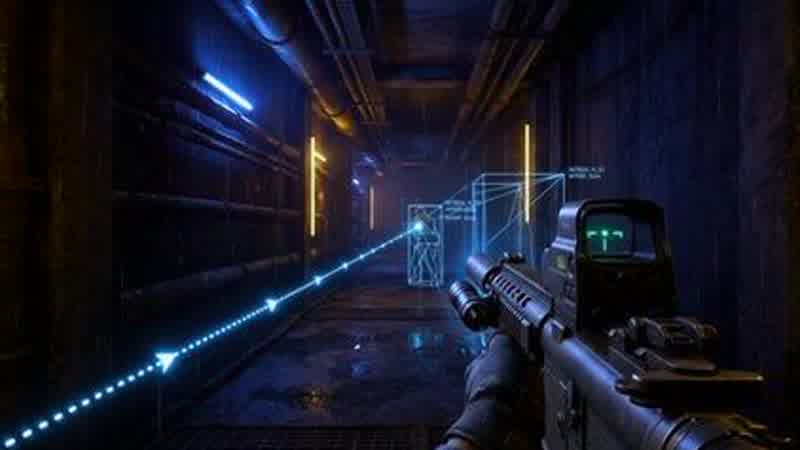
In tactical first-person shooters with sub-200ms Time-to-Kill (TTK)—such as Counter-Strike 2, Valorant, and Tom Clancy's Rainbow Six Siege—holding a completely stationary angle can sometimes feel like a disadvantage against an opponent swinging out at full movement velocity.
This phenomenon is known as Peeker's Advantage, and it is not a bug: it is an unavoidable mathematical consequence of the speed of light in fiber-optic cables, client-side prediction, and server-side Lag Compensation (Backward Reconciliation).
Title: The Peeker's Advantage Mathematical Equation
Badge: Netcode Physics
- The Total Visibility Window: `T_advantage = (RTT_peeker ÷ 2) + T_server_tick + (RTT_defender ÷ 2) + T_interp_defender`
- Low-Ping LAN Scenario (5ms RTT): Only ~22ms of advantage (imperceptible to human reaction times of ~160ms–200ms).
- High-Ping Online Scenario (80ms Peeker vs. 30ms Defender + 15.6ms Interp): Over 78ms to 95ms of visibility advantage before the defender's client renders the swing.
- Tactical Counterplay: Jiggle-peeking and un-peeking reset the visibility clock so you become the peeker rather than a static target stored in the enemy's interpolation history.
Step-by-Step Timeline of a Corner Swing
Imagine Player A (The Peeker) has a 50ms ping (`25ms one-way`) and Player B (The Defender) is standing completely still holding the corner with a 40ms ping (`20ms one-way`):
1. T = 0 ms: Player A presses `D` to strafe out from behind the wall. Because of Client-Side Prediction, Player A's character moves immediately on their own monitor at `T = 0 ms`. Since Player B is already standing stationary at that corner, Player B's position is already known to Player A's client—so Player A sees Player B immediately as they clear the wall.
2. T = 25 ms: Player A's movement packet arrives at the authoritative game server.
3. T = 33 ms: The server finishes processing the current simulation tick and broadcasts the new world snapshot out to all connected clients.
4. T = 53 ms: The snapshot arrives at Player B's PC (`33ms + 20ms one-way transit`).
5. T = 68.6 ms: Player B's client holds the snapshot in its Entity Interpolation Buffer (typically 1 to 2 ticks, or ~15.6ms) so remote player animations interpolate smoothly without teleporting.
Only at T = 68.6 ms does Player B's monitor actually begin drawing Player A rounding the corner!
How Server Lag Compensation Validates the Shot
Meanwhile, if Player A has pre-aimed the common angle and fires at `T = 165 ms`, the server receives the shot packet along with the exact client view timestamp. Using Backward Reconciliation, the server rewinds its historical hitbox buffer to the exact millisecond Player A saw on their screen, confirms the headshot was valid, and sends the elimination notice to Player B—sometimes before Player B's reaction time (180ms + 68.6ms network delay = 248.6ms) even allows them to fire a single bullet back.
How to Defeat Peeker's Advantage in Ranked Play
1. Play Off-Angles: Peeker's Advantage is only lethal if the peeker pre-aims your exact head position immediately upon clearing the wall. Standing half a meter wider or tighter forces the peeker to spend 120ms+ visually acquiring and micro-flicking to you.
2. Periodic Shoulder / Jiggle Holding: Instead of standing motionless for 15 seconds, strafe behind cover and re-peek every 1.5 seconds. Because your position is constantly changing, an opponent swinging the corner sees your past interpolated position behind cover while you gain Peeker's Advantage on your re-swing.