
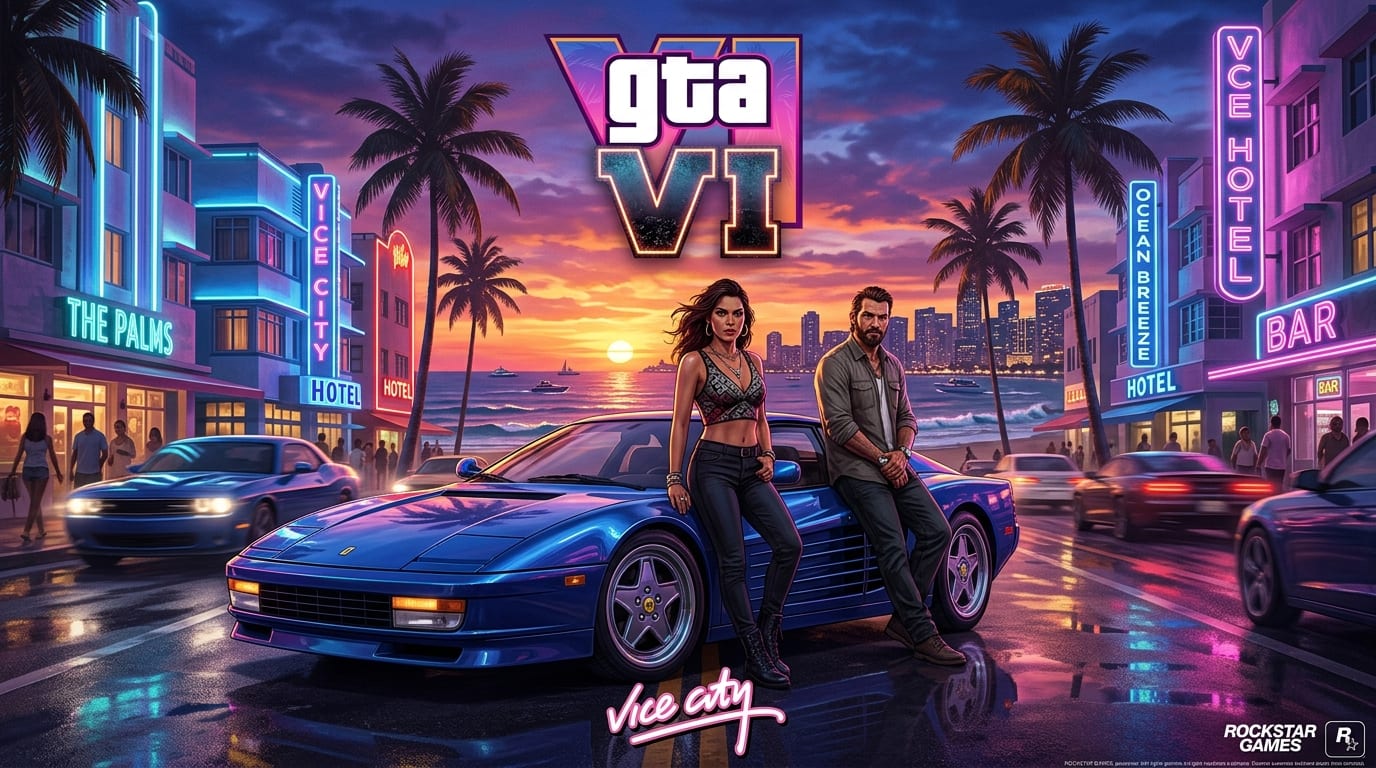
When Rockstar Games unveiled the state of Leonida in Grand Theft Auto VI, graphics programmers across the industry immediately zoomed in on three technical marvels: the car side-mirrors and window glass reflecting off-screen neon signs, the individual hair strand physics and crowd animation variety on Vice Beach, and the physical wake interaction of airboats carving through the Grassrivers wetlands.
Under the hood of Grand Theft Auto VI sits the ninth major generational evolution of the Rockstar Advanced Game Engine (RAGE 9)—a proprietary engine architecture specifically designed to stream dense urban and tropical simulation data across unified console and PC memory architectures.
Title: 4 Core Engineering Pillars of RAGE 9 in GTA VI
Badge: Engine Deep Dive
- 1. Hybrid Ray-Traced Global Illumination (RTGI) & Reflections: Uses BVH acceleration structures so neon signage in Vice City casts accurate colored bounce lighting onto wet asphalt and vehicle interiors—even when the light source is behind the camera.
- 2. Shallow-Water & FFT Ocean Fluid Simulation: Combines Fast Fourier Transform (FFT) deep-ocean swells with local interactive heightfield fluid grids for surfboards, speedboats, and storm surges.
- 3. Finite-Element Soft-Body Vehicle Deformation: Expands chassis crumple zones into sub-component suspension arms, tie rods, and panel latches.
- 4. Contextual Utility AI + Motion Matching: Eliminates robotic NPC animation snaps by blending thousands of mocap locomotion frames dynamically based on terrain slope and crowd proximity.
Why Ray-Traced Reflections Transform an Urban Open World
In older open-world games relying on Screen-Space Reflections (SSR) or low-resolution Cube Maps, driving a sports car down a neon-lit boulevard at night exposed a glaring visual artifact: the moment you tilted the camera down toward the hood, the skyscrapers disappeared from the screen, causing their reflections on your wet hood and puddles to vanish into muddy blurs. Furthermore, car wing mirrors could never show actual traffic behind you because SSR cannot reflect geometry outside the camera frustum.
By integrating a dedicated Ray-Traced BVH Reflection & GI pipeline directly into RAGE 9's deferred renderer, every chrome bumper, store window, and rain puddle in Vice City queries the actual 3D world geometry around the player.
Motion Matching and High-Density Crowd Simulation
In Red Dead Redemption 2, Saint Denis pushed eighth-generation console CPUs to their absolute limit with ~40 to 50 simultaneous NPCs on screen. In Leonida, beach boardwalks and nightclubs render over 150+ unique characters simultaneously, each utilizing Motion Matching and procedural inverse kinematics (IK) so characters step naturally over sand dunes, carry objects of varying weight, and react organically to sudden weather changes or street chaos. Check launch dates and platform milestones in our Verified Game Release Calendar.