
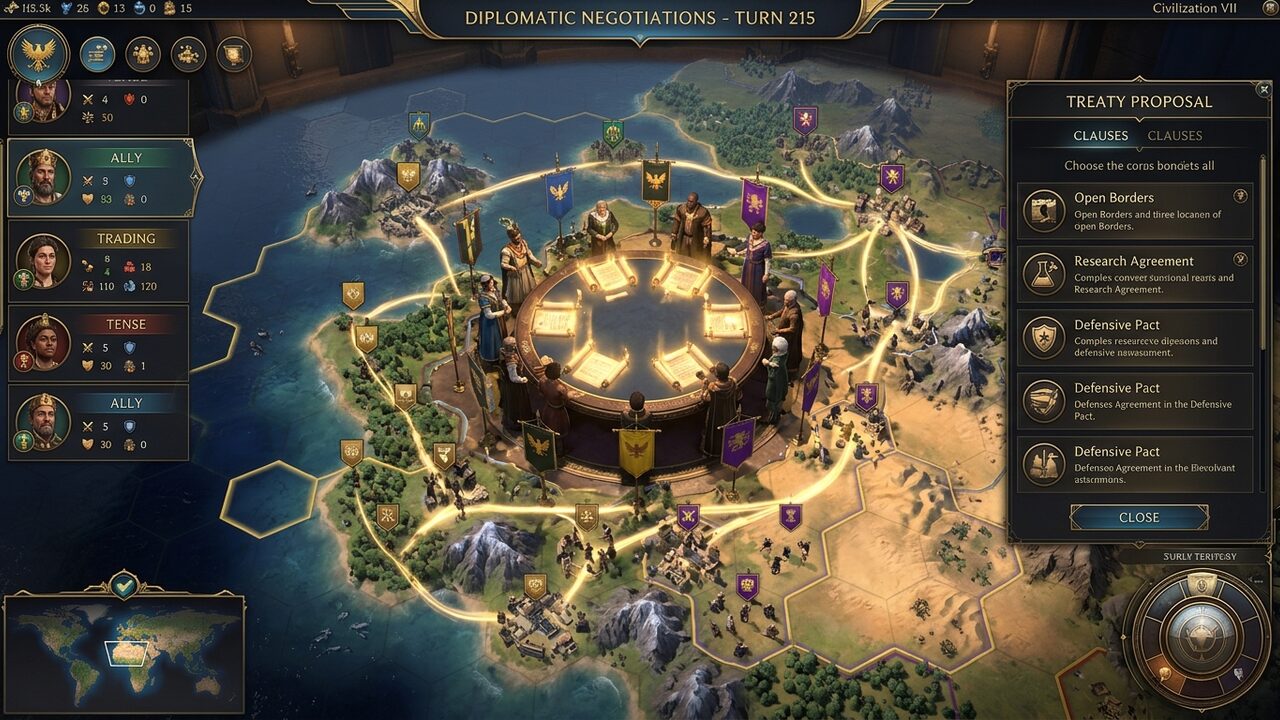
In Sid Meier's Civilization VII, Firaxis Games completely dismantled the legacy diplomatic systems of previous franchise entries. Gone are the transactional, transactional gold-for-favor trades and binary warmonger grievance penalties of Civilization VI. In their place stands a sophisticated, interconnected Influence Economy, dynamic Leader Persona traits, systemic Age Transition treaties, and an unprecedented diplomatic mechanism: the ability to maintain Armed or Peaceful Neutrality by paying recurring Influence subsidies instead of automatically being dragged into catastrophic military crusades.
For grand strategy players pursuing Cultural, Scientific, or Economic Victory conditions, an allied declaration of war has historically been an empire-derailing catastrophe. In past Civilization games, when an aggressive AI ally declared a defensive or offensive war against your key trading partner, you were trapped in an unpalatable dilemma: either dishonor your solemn alliance—earning severe diplomatic penalties across the entire globe—or enter an unwanted military meat-grinder that drained your treasury, incinerated production, and pillaged your vital international trade routes.
In Civilization VII, the new Influence-Based Alliance Architecture fundamentally solves this problem. However, leveraging neutrality is not free. Influence is the single most valuable non-material currency in the game, required for enacting domestic policies, suzeraining Independent Peoples (City-States), resolving Age Transition Crises, and claiming contested frontier territories. Spending scarce Influence to decline an ally's war call represents a massive opportunity cost.
At Game Vault Forum, founded by Joel Ayuba (LinkedIn Profile | Company Page), our Grand Strategy Desk spent hundreds of turns dissecting Civilization VII's diplomatic code, AI decision trees, and economic math. This masterclass guide breaks down the exact mechanics of peaceful alliances, calculates the true economic cost of military mobilization versus Influence buyouts, and provides a rigorous strategic decision framework on exactly when to pay Influence to stay out of a war.
Title: Civilization VII Peaceful Diplomacy Matrix
Badge: Grand Strategy
- The Influence Neutrality Rule: In Civ VII, when an ally calls you into a war, you can invoke "Diplomatic Non-Belligerence" by paying a recurring Influence maintenance fee (scaling by era and empire size) to remain at peace with both parties.
- True Cost of War: Entering a war rarely costs just military unit production; it halts bilateral trade routes, triggers the "War Fatigue" domestic production penalty (-15% to -35%), and severs compounding Research Agreement yields.
- The Cross-Alliance Schism: If two empires with whom you hold mutual Formal Alliances go to war against each other, neutrality fees double (+100% Influence surcharge), forcing a strategic decision within 10 turns.
- Age Transition Carry-Over: Influence reserves invested in "Diplomatic Legacy Pacts" during the Exploration and Modern Age Transitions permanently preserve alliance tiers into the next historical era.
---
1. The Influence Economy: Understanding Civilization VII's Diplomatic Core
To master peaceful alliances, you must understand how Influence is generated, stored, and expended in Civilization VII:
1. Influence Generation Vectors
Unlike Gold or Production, Influence cannot simply be mined from tiles. It is derived through specialized statecraft:
- Diplomatic Quarters & Embassies: Constructing Chanceries and Consulates in your capital generates a steady baseline of +4 to +12 Influence per turn.
- Envoys Assigned to Independent Peoples: Stationing envoys with neutral city-states generates Influence while progressing toward suzerainty.
- Civic Tree & Leader Persona Synergies: Diplomatic and philosophical leaders (such as Hatshepsut, Confucius, or Benjamin Franklin) possess unique passive abilities that amplify Influence generation whenever international trade routes are active.
- Festival & Banquet Projects: Sponsoring Imperial Banquets in your cultural hubs converts excess Food and Happiness directly into immediate bursts of Influence.
2. The Opportunity Cost of Influence
Every single point of Influence spent on peacekeeping is a point that cannot be invested in:
- Absorbing high-yield Independent Peoples into your empire
- Purchasing exclusive luxury resource monopolies
- Passing sweeping ideological resolutions in the World Congress
- Stabilizing unrest during the dreaded Age Transition Crises
Therefore, treating Influence as an infinite war-avoidance shield is a fatal strategic mistake. You must calculate whether paying Influence preserves more economic value than the war would destroy.
---
2. Quantifying the True Cost of War: The Hidden Economic Drain
Many strategy players assume that joining an ally's war costs nothing if the enemy is geographically distant: "I will simply accept the war call, send no troops, and remain at peace while my ally fights."
In Civilization VII, the AI and game systems actively punish this passive "phony war" tactic through systemic economic penalties:
Penalty 1: Immediate Trade Route Annihilation
The moment you enter a state of war with another civilization:
- Every active maritime and terrestrial trade route passing through the enemy's territory or connecting to their cities is instantly pillaged and destroyed.
- You lose both the raw Gold, Science, and Culture yields of those routes and the physical Trader units themselves, which cost 90 to 220 Production to rebuild.
- For a trade-focused empire, losing six active trade routes represents an immediate loss of +80 Gold, +45 Science, and +30 Culture per turn.
Penalty 2: The War Weariness Production Choke
Civilization VII introduces an escalating Domestic War Exhaustion mechanic. As turns pass without a peace treaty, your civilian population accumulates war fatigue:
- Amenity and Happiness ratings across all your cities decline by 1 point every 6 turns of active war.
- When a city's Happiness drops into "Discontented" status, city-wide Production and Science yields suffer a flat -20% penalty.
- In extreme cases, rebel partisan units spawn in your peripheral farm districts, plundering improvements and forcing you to construct defensive garrison units.
Penalty 3: Severing Compounding Research Agreements
Scientific Alliances in Civilization VII feature compounding yield multipliers: the longer an alliance persists without interruption, the higher the mutual research bonus climbs (capping at a massive +25% boost to discovered technologies). Entering a war that severs diplomatic ties resets that historical progression counter to zero.
---
3. The Alliance Hierarchy Across Historical Ages
Civilization VII organizes diplomacy into clear, tiered treaties that require specific levels of mutual diplomatic trust:
| Alliance Tier | Influence Maintenance | Core Benefits | War Call Obligation |
| :--- | :--- | :--- | :--- |
| Friendship Pact | None (Free) | Open Borders, Non-Aggression, Basic Trade | None (Cannot be called to war) |
| Cooperative Treaty | 50 Influence upfront | Shared World Map Visibility, +10% Trade Yields | Optional (Can decline with zero penalty) |
| Formal Alliance | 15 Influence / Turn | Specialized Tier Bonuses (Science / Culture / Wealth) | Mandatory War Call (Neutrality costs Influence) |
| Defensive Coalition | 25 Influence / Turn | Immediate Mutual Defense, Shared Radar/LoS | Automatic Belligerence (Requires high buyout fee) |
The Specialized Alliance Branches:
1. Scientific Alliance: Grants mutual Eureka boosts when an ally researches a shared technology; unlocks joint archaeological excavations in the Exploration Age.
2. Economic Alliance: Eliminates foreign trade tariffs, allows direct purchase of foreign luxury amenities with domestic gold, and grants +2 Production per active trade route.
3. Cultural Alliance: Eliminates border culture pressure, immunizing your peripheral cities from loyalty rebellion, and amplifies tourist attraction yields by 30%.
4. Military Alliance: Shares real-time military unit line-of-sight, grants +5 Combat Strength when fighting within 4 tiles of allied units, and accelerates general production of siege weaponry.
---
4. The Influence Buyout Mechanism: How to Remain at Peace
When an allied leader with whom you share a Formal Alliance or Defensive Coalition is attacked (or initiates a declared war), an urgent diplomatic emergency modal appears:
title: Diplomatic Emergency Resolution Framework: War Call Options
badge: High Council Protocol
- Option A: Honor Alliance & Mobilize (Military Belligerence): Declare war on the rival empire immediately. Cost: 0 Influence. Result: Maximum alliance trust preserved; bilateral trade with rival severed.
- Option B: Invoke Diplomatic Neutrality (Influence Buyout): Retain peaceful trade and open borders with both ally and enemy. Cost: Dynamic recurring Influence fee for 15 turns. Result: Minor allied trust cooldown (-15 for 10 turns) with zero military losses.
- Option C: Dishonor Alliance & Fracture Pact: Unilaterally tear up the mutual defense treaty. Cost: 0 Influence. Result: Catastrophic Treacherous reputation penalty (-50 Trust with all known world leaders).
The Mathematical Formula Behind Neutrality Maintenance
The recurring Influence cost per turn to purchase non-belligerence is determined by empire scale, historical friction, and global age:
| Civilization Age | Base Influence Cost | Small Empire (Pop <50) | Medium Empire (Pop 50–100) | Sprawling Megalopolis (Pop >150) | Impact on Domestic Policy |
| :--- | :--- | :--- | :--- | :--- | :--- |
| Antiquity Age | 4 Influence / Turn | 4 – 6 / Turn | 7 – 9 / Turn | 10 – 14 / Turn | Minimal; minor delay to town founding |
| Exploration Age | 8 Influence / Turn | 9 – 12 / Turn | 14 – 18 / Turn | 20 – 28 / Turn | Moderate; delays colonial charters |
| Modern Age | 16 Influence / Turn | 18 – 24 / Turn | 28 – 36 / Turn | 38 – 52 / Turn | Severe; paralyzes ideological diplomacy |
If you possess a massive, sprawling empire with 150 total population in the Modern Age, maintaining neutrality can demand upwards of 35 to 45 Influence per turn. If your monthly surplus is only +50 Influence, paying for peace will virtually paralyze your domestic statecraft for the duration of the treaty!
---
5. Strategic Decision Framework: When to Pay vs. When to Mobilize
To prevent disastrous diplomatic blunders, apply our lab's battle-tested strategic decision tree:
| Primary Assessment Criterion | Secondary Condition | Recommended Diplomatic Action | Resource Allocation & Strategy |
| :--- | :--- | :--- | :--- |
| Enemy shares no land border with you | Zero active trade routes with enemy | HONOR ALLIANCE (Join War) | Declare "Phony War". Distance prevents enemy invasion; saves 100% of your Influence. |
| Enemy is a major trading partner | Multi-city trade routes generating >40 Gold | PAY INFLUENCE (Buyout) | Protect trade economy. Trade revenues vastly exceed the Influence maintenance fee. |
| Enemy is an aggressive immediate neighbor | Your standing military is unprepared | PAY INFLUENCE (Buyout) | Buy 15 turns of peace while pivoting domestic production entirely to defensive forts. |
| Enemy is an aggressive immediate neighbor | Your army holds technological superiority | HONOR ALLIANCE (Join War) | Mobilize immediately and conquer border frontier cities without warmonger penalties. |
| Two formal allies declare mutual war | Both relationships vital to win condition | DOUBLE BUYOUT -> SUMMIT | Pay temporary neutrality on both sides; immediately sponsor a World Congress Ceasefire. |
title: Core Rule of Civilization VII Influence Statecraft
badge: Grand Strategy Law
Never spend gold or influence on defensive armies when geographic oceans or neutral city-states physically separate you from an allied conflict. Join the war on paper, collect maximum alliance trust from your ally, and maintain 100% civilian economic growth. Only pay Influence when direct military invasion threatens your borders or when broken trade routes would bankrupt your empire.
Scenario 1: The Distant Border Dispute (JOIN WAR)
- Situation: Your ally in the northern hemisphere declares war on an empire located across an ocean on another continent. You share zero land borders with the enemy and maintain zero active trade routes with them.
- Recommendation: Join the War. Because the enemy is thousands of miles away, they cannot project military force across the ocean to harm your homeland. You pay zero Influence, keep your alliance relationship at 100% maximum trust, and suffer negligible consequences.
Scenario 2: The Critical Trade Partner Clash (PAY INFLUENCE)
- Situation: Your ally attacks your primary trade partner, with whom you have four high-yield trade routes delivering +60 Gold and vital Iron/Coal strategic resources.
- Recommendation: Pay Influence for Neutrality. The economic value of your uninterrupted trade routes and resource access vastly outweighs the Influence maintenance fee. Allowing those trade routes to be plundered would cost hundreds of Gold and stall your domestic infrastructure.
Scenario 3: The Cross-Alliance Schism (THE DIPLOMATIC NIGHTMARE)
- Situation: Empire A and Empire B both hold Formal Alliances with you, but declare war on each other.
- Recommendation: Emergency Summit Protocol. If you have high Influence reserves, pay the double neutrality fee for 5 turns while immediately assigning all your available Envoys to sponsor a Mediation Summit in the World Congress. Sponsoring an enforced ceasefire terminates the conflict between your allies before your Influence reserves run dry.
---
6. Managing Age Transitions Without Alliance Collapse
Civilization VII's signature mechanic is the Age Transition (moving from Antiquity into Exploration, and from Exploration into Modern). During an Age Transition:
- The global map reshapes, historical crises erupt, and all legacy alliances automatically expire unless proactively safeguarded.
- To prevent your peaceful empire from being abandoned into a hostile diplomatic vacuum, you must invest banked Influence into Legacy Alliance Treaties during the final 15 turns of an Age.
- Banking at least 350 Influence prior to an Age Transition guarantees that your core trade alliances instantly carry over into the new historical era on Turn 1, giving your empire an insurmountable economic advantage while rival AI empires descend into border skirmishes.
---
7. The Peaceful Diplomat's Cheat Sheet
| Diplomatic Scenario | Primary Action | Cost Impact | 10-Turn Strategic Outcome |
| :--- | :--- | :--- | :--- |
| Allied Defensive War (Distant Enemy) | Accept War Call | 0 Influence | Flawless alliance trust; zero combat risk |
| Allied Offensive War (Key Trade Partner) | Pay Neutrality Fee | Moderate Influence / Turn | Trade routes preserved; economy booming |
| Neighboring Warmonger Incursions | Pay Neutrality + Fortify | High Influence / Turn | Prevents multi-front domestic invasion |
| Two Allies Wage Mutual War | Double Neutrality -> Peace Summit | Severe Influence drain | Preserves both diplomatic relationships |
| Age Transition Horizon (<15 Turns) | Hoard Influence for Legacy Pacts | Strict conservation | Seamless alliance carryover into next Age |
For companion grand strategy diagnostics, test system benchmarks in our FPS Calculator, check hardware limits in our PC Game Requirements Checker, and discuss civilization builds in the Game Vault Community Forum.